
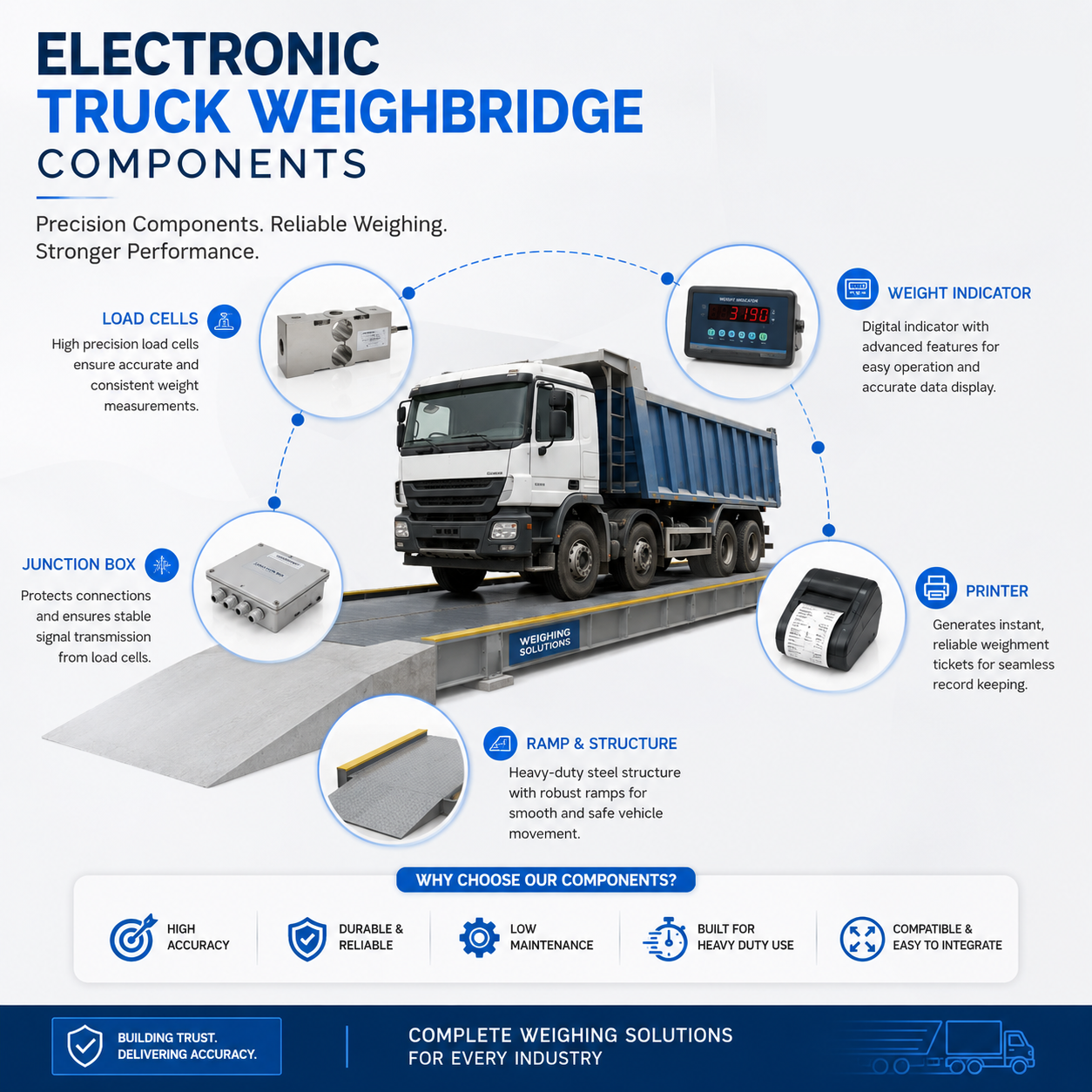
Heavy-duty electronic truck weighbridges play an essential role in industries where trucks carrying large quantities of raw materials, finished goods, minerals, agricultural products, construction materials, and other commodities need to be weighed accurately.
A reliable truck weighbridge is more than just a steel platform. It is a complete weighing system made up of several critical components, including load cells, weighbridge decks, junction boxes, digital indicators, cables, software, and structural and foundation elements. Each component works together to deliver accurate, consistent, and dependable weight measurements.
In this guide, we explore the major components of a heavy-duty electronic truck weighbridge, their functions, and the factors businesses should consider when selecting a reliable system.
What Is a Heavy-Duty Electronic Truck Weighbridge?
A heavy-duty electronic truck weighbridge is a large weighing system designed to measure the gross weight of trucks and other heavy commercial vehicles.
Unlike traditional mechanical weighing systems, electronic weighbridges use load cells and digital electronics to detect and calculate the weight placed on the platform. The weight measurement is then displayed on a digital indicator and can also be recorded through dedicated weighbridge software.
These systems are commonly used in:
- • Manufacturing plants
- • Cement and steel industries
- • Mining and quarrying
- • Logistics and transportation
- • Warehouses and distribution centres
- • Agricultural facilities
- • Construction sites
- • Ports and industrial facilities
- • Waste management facilities
- • Food processing industries
For demanding industrial applications, every component must be designed to withstand heavy vehicle traffic, changing weather conditions, vibration, dust, and continuous operation.
Main Components of a Heavy-Duty Electronic Truck Weighbridge
A complete electronic truck weighbridge generally consists of the following major components:
- 1. Weighbridge platform or deck
- 2. Load cells
- 3. Junction box
- 4. Digital weight indicator
- 5. Cables and wiring
- 6. Weighbridge software
- 7. Foundation and structural components
- 8. Safety and traffic management accessories
The weighbridge platform is the main structure on which the truck is positioned during weighing. It must be strong enough to support the maximum vehicle load and withstand repeated loading and unloading cycles.
Heavy-duty weighbridge platforms are generally manufactured using robust structural steel components. Depending on the application and installation requirements, platforms may be available in different lengths, widths, and configurations.
Key considerations for a weighbridge deck include:
- • Maximum weighing capacity
- • Platform dimensions
- • Structural strength
- • Steel quality
- • Surface design
- • Corrosion resistance
- • Vehicle traffic frequency
- • Installation environment
The platform should provide sufficient space for the vehicle to remain completely on the weighing surface during the weighing process.
A properly designed deck also helps distribute the vehicle load effectively to the load cells underneath.
2. Load Cells
Load cells are among the most important components of an electronic truck weighbridge.
They convert the mechanical force generated by the truck’s weight into an electrical signal. This signal is then processed by the weighing system to calculate the vehicle’s weight.
In simple terms:
Truck Load → Weighbridge Platform → Load Cells → Electrical Signal → Weight Indicator → Weight Reading
Heavy-duty weighbridges typically use multiple load cells positioned strategically beneath the platform.
Why Are Load Cells Important?
The accuracy and reliability of a weighbridge depend significantly on the quality and performance of its load cells.
When selecting load cells, businesses should consider:
- • Rated capacity
- • Accuracy
- • Environmental protection
- • Overload protection
- • Temperature stability
- • Construction material
- • Resistance to moisture and dust
- • Long-term durability
For outdoor and industrial applications, appropriately protected load cells are particularly important because they may be exposed to rain, dust, chemicals, vibration, and temperature fluctuations.
3. Junction Box
The junction box connects multiple load cells and combines their signals before sending them to the weight indicator.
Since a heavy-duty truck weighbridge can contain several load cells, the junction box plays an important role in managing and balancing their signals.
Functions of a Junction Box
A junction box can:
- • Connect multiple load cells
- • Combine electrical signals
- • Facilitate signal adjustment
- • Protect connections
- • Simplify maintenance
- • Help with troubleshooting
The junction box should be properly protected against moisture, dust, corrosion, and other environmental conditions.
A high-quality junction box can contribute to stable and consistent weighing performance.
4. Digital Weight Indicator
The digital weight indicator is the electronic interface that receives signals from the load cells and converts them into a readable weight measurement.
The measured weight is displayed digitally, allowing the operator to quickly determine the vehicle’s gross or net weight.
Depending on the system configuration, a digital indicator may provide features such as:
- • Large digital display
- • Gross, tare, and net weight functions
- • Zero tracking
- • Calibration functions
- • Data communication interfaces
- • Error detection
- • Printer connectivity
- • Computer connectivity
For industrial environments, the indicator should be easy to operate and capable of providing clear readings even under demanding working conditions.
5. Cables and Wiring
Cables are sometimes overlooked when selecting a weighbridge, but they are essential for reliable signal transmission.
Load cell cables carry electrical signals from the load cells to the junction box and weighing indicator. Any damage, poor connection, moisture ingress, or electromagnetic interference can potentially affect system performance.
Important cable considerations include:
- • Cable quality
- • Proper insulation
- • Environmental protection
- • Moisture resistance
- • Mechanical protection
- • Correct installation
- • Secure connections
For outdoor installations, cables should be routed and protected appropriately to reduce the risk of damage from vehicles, water, rodents, chemicals, or other environmental factors.
Regular inspection of cable connections can also help prevent unexpected weighing issues.
6. Weighbridge Software and Computer System
Modern electronic weighbridges can be integrated with dedicated software to automate weighing operations and maintain digital records.
Instead of manually recording vehicle weights, software can capture and store important transaction information.
Depending on the system, weighbridge software may record:
- • Vehicle registration number
- • Gross weight
- • Tare weight
- • Net weight
- • Date and time
- • Material details
- • Customer or supplier information
- • Operator details
- • Transaction number
Benefits of Weighbridge Software
A digital weighing management system can help businesses:
- • Reduce manual data entry
- • Improve record keeping
- • Minimise human errors
- • Track vehicle movements
- • Generate reports
- • Improve inventory monitoring
- • Simplify audits
- • Integrate weighing data with business systems
For companies handling a high volume of trucks, automated weighbridge software can significantly improve operational efficiency.
7. Foundation and Structural Components
The weighbridge platform and electronic components are only part of the overall system. A strong and properly engineered foundation is equally important.
The foundation supports the weighbridge structure and transfers the vehicle load safely into the ground.
Depending on the site and installation design, a weighbridge may be installed using different foundation arrangements.
Important foundation considerations include:
- • Soil conditions
- • Drainage
- • Ground stability
- • Local climate
- • Vehicle traffic
- • Weighbridge dimensions
- • Maximum capacity
- • Installation type
- • Site accessibility
- • Soil conditions
- • Drainage
- • Ground stability
- • Local climate
- • Vehicle traffic
- • Weighbridge dimensions
- • Maximum capacity
- • Installation type
- • Site accessibility
Poor drainage or an improperly designed foundation can create problems over time, including structural movement, water accumulation, and weighing inaccuracies.
Therefore, site preparation and foundation design should be treated as critical parts of the weighbridge installation process.
8. Safety and Traffic Management Accessories
A busy industrial weighbridge needs more than weighing equipment. Safety accessories can help control vehicle movement and improve operational efficiency.
Depending on the site requirements, a truck weighbridge installation may include:
- • Traffic lights
- • Boom barriers
- • Vehicle positioning indicators
- • Safety railings
- • Warning signs
- • Wheel guides
- • Cameras
- • Automatic number plate recognition systems
- • RFID systems
- • Driver display units
These accessories can help ensure that trucks are positioned correctly and safely during the weighing process.
How Does an Electronic Truck Weighbridge Work?
Understanding the weighing process helps explain how all the components work together.
Step 1: Truck Enters the Weighbridge
The vehicle drives onto the weighbridge platform and is positioned within the designated weighing area.
Step 2: Load Is Transferred to the Load Cells
The weight of the truck is transferred through the platform structure to the load cells.
Step 3: Load Cells Generate Electrical Signals
The load cells detect the applied force and generate corresponding electrical signals.
Step 4: Signals Reach the Junction Box
The signals from the individual load cells are combined and managed through the junction box.
Step 5: Weight Indicator Processes the Signal
The weighing indicator processes the signal and calculates the vehicle’s weight.
Step 6: Weight Is Displayed
The final weight measurement appears on the digital display.
Step 7: Data Is Recorded
If software is connected to the weighbridge, the transaction can be automatically recorded for future reference
This integrated process allows businesses to achieve faster and more systematic vehicle weighing.
What Makes a Heavy-Duty Weighbridge Reliable?
The reliability of a truck weighbridge depends on the combined performance of its mechanical, electronic, and software components.
Some of the most important factors include:
Robust Construction
The platform should be designed to handle repeated heavy vehicle loads without excessive deformation or structural damage.
Quality Load Cells
Reliable load cells are essential for maintaining accurate weight measurements.
Proper Installation
Correct installation and alignment of the platform and load cells are crucial for dependable operation.
Environmental Protection
Outdoor weighbridges should be appropriately protected against rain, dust, moisture, corrosion, and temperature variations.
Regular Calibration
Periodic calibration helps maintain weighing accuracy and ensures that the system continues to perform according to applicable requirements.
Preventive Maintenance
Regular inspection can identify damaged cables, loose connections, debris accumulation, structural issues, or other potential problems before they affect operations.
How to Choose the Right Heavy-Duty Electronic Truck Weighbridge Components
Selecting the right components depends on the application, vehicle type, operating environment, and weighing requirements.
Before purchasing a system, consider the following factors.
1. Determine the Required Capacity
Choose a weighbridge capacity based on the maximum loaded vehicle weight expected at the facility.
The system should be suitable for the heaviest vehicles that will routinely use it.
2. Select the Appropriate Platform Size
Platform dimensions should accommodate the longest and widest vehicles that need to be weighed.
3. Consider the Operating Environment
For outdoor industrial applications, components should be selected according to environmental conditions such as:
- • Rain
- • Dust
- • Humidity
- • Temperature changes
- • Corrosive environments
- • Heavy vehicle traffic
4. Evaluate Load Cell Quality
Load cells should be selected based on their capacity, accuracy, durability, and environmental protection.
5. Consider Automation Requirements
Businesses handling large numbers of trucks may benefit from automated software, RFID, cameras, barriers, and vehicle identification systems.
6. Check Service and Maintenance Support
Reliable technical support, spare parts availability, calibration services, and maintenance assistance can be important for long-term operation.
Common Applications of Heavy-Duty Electronic Truck Weighbridges
Heavy-duty truck weighbridges are used across a wide range of industries.
Mining and Quarrying
Weighbridges help measure incoming and outgoing materials such as minerals, aggregates, stone, and other extracted materials.
Manufacturing
Factories use weighbridges to monitor raw materials entering the facility and finished goods leaving the site.
Logistics and Transportation
Transport companies can use weighing systems to monitor vehicle loads and maintain digital shipment records.
Agriculture
Agricultural facilities can weigh trucks carrying grains, crops, fertilisers, animal feed, and other materials.
Construction
Construction companies and material suppliers can weigh trucks transporting sand, cement, aggregates, steel, and other construction materials.
Waste Management
Weighbridges can record the weight of waste entering or leaving waste processing and disposal facilities.
Maintenance Tips for Electronic Truck Weighbridges
Regular maintenance can help extend the service life of a weighbridge and maintain reliable performance.
Keep the Platform Clean
Remove mud, stones, debris, and other materials that may accumulate around the platform.
Inspect Load Cells
Regularly check load cells for signs of damage, corrosion, moisture ingress, or abnormal movement.
Check Cables and Connections
Inspect cables, junction boxes, and electrical connections for damage or loose connections.
Monitor the Foundation
Look for cracks, water accumulation, settlement, or other signs of foundation problems.
Perform Calibration
Periodic calibration helps verify that the weighbridge continues to provide accurate measurements.
Check Safety Equipment
Traffic lights, barriers, cameras, and other accessories should be inspected regularly to ensure proper operation.
Why Component Quality Matters
A truck weighbridge operates as an integrated system. Even if the platform is structurally strong, poor-quality electronic or weighing components can affect the overall performance of the system.
For example, a damaged cable can interrupt signal transmission. A faulty load cell can affect weight readings. Poor drainage can damage components and the foundation. Inadequate software can create difficulties in managing transaction records.
Therefore, businesses should evaluate the complete weighing system rather than focusing on a single component.
A well-engineered combination of mechanical components, load cells, electronics, software, and structural elements can provide dependable performance over the long term.
Conclusion
Heavy-duty electronic truck weighbridges are sophisticated weighing systems designed to handle demanding industrial applications. Their performance depends on the interaction between several key components, including the weighbridge platform, load cells, junction box, digital weight indicator, cables, software, foundation, and safety accessories.
Choosing high-quality components, ensuring proper installation, conducting regular maintenance, and performing periodic calibration can help businesses maintain reliable weighing operations.
Whether used in mining, manufacturing, logistics, agriculture, construction, or waste management, a properly designed electronic truck weighbridge can help businesses improve weight measurement, record keeping, operational control, and overall efficiency.
When selecting a heavy-duty truck weighbridge, it is important to consider not only the weighing capacity and platform size but also the quality of the components, installation requirements, automation options, environmental conditions, and after-sales support.
A complete and well-integrated weighing solution can provide the durability and accuracy required for today’s high-volume industrial operations.


